
How a Wikipedia citation can benefit your research (yes, really)
This blog post was originally published on the Sage Perspectives blog here
Silvia Gutiérrez is the Senior Program Officer for Libraries at the Wikimedia Foundation, where she supports global library partnerships drawing on her background as a Wikimedian, research librarian, and computational humanist. Previously, she was a Digital Humanities academic at the Daniel Cosío Villegas Library, leading Wikimedia campaigns focused on social movements, linguistic diversity, and gender equity. She is a Ph.D. student at the University of Leipzig researching Wikipedia references with AI and data visualization, and a co-founder of R-Ladies CDMX.
You’ve probably heard it before: “Never cite Wikipedia in your research paper.” And it’s good advice. But maybe you haven’t heard about how using Wikipedia (especially its citations) actually strengthens your work and even helps others discover it later. And this post is all about that!
Start Here: Wikipedia as The Research Launchpad
Many academic librarians actually encourage students to begin with Wikipedia, not as a source to cite, but as a map to credible sources. For example, the CMU Libraries guide to web research explicitly recommends Wikipedia as a starting point for understanding a topic:
“You can see that the sources cited include books (with ISBNs), information from college or university websites (ending in .edu), and articles (with DOIs). These are all sources you could safely use in a research paper, all located in one place.”
— LibGuides at Central Michigan University
Wikipedia is a curated bibliography of thousands of topics, constantly updated by a global community of ~300,000 volunteers!
Wikipedia Citations as an Altmetric Signal
Beyond being a source-finding tool, Wikipedia is increasingly recognized as a meaningful Altmetric indicator. A 2020 study published in PLOS ONE analyzed over 1.4 million Wikipedia citations to scientific articles. The authors found that being cited on Wikipedia is a sign of societal impact—it means your work is being integrated into public knowledge.
“Wikipedia references to scientific articles can provide highly valuable altmetric information given that the inclusion of references is not a trivial activity and is usually subject to community scrutiny.”
In fact, Altmetric.com gives Wikipedia citations a weight of 3—higher than mentions on X (1) or Facebook (0.25). This reflects the careful, community-vetted process behind adding citations to Wikipedia.
But Not All Wikipedias Are Created Equal
While English Wikipedia is often rich in citations, the same isn’t true for every language edition. A recent study (May 2025) analyzed 55 language editions. They found stark disparities in citation quality across topics and languages.
For example:
In English Wikipedia, business-related articles scored an average quality of ~70%.
In Chinese Min Nan Wikipedia, the same topic scored only ~12%.
This highlights an important caveat: citation quality varies widely. The good news is that if you speak one of these lesser-developed languages, you could be the change you want to see!
How You Can Contribute (Ethically!)
If you're a researcher, you might wonder: Can I add citations to my own work on Wikipedia? The answer is yes, you can, and maybe you should? But as you would do with any self-citation, you should do it with care.
Wikipedia has clear guidelines on conflicts of interest. You're allowed to cite your own published work if it's relevant, conforms to content policies, and isn't excessive. The key is to:
Write in the third person – don't use "my research shows," but rather cite the paper objectively.
Avoid over-citing yourself – balance your citations with other relevant research.
When in doubt, propose edits on the article's talk page and let the community review them first.
Adding your work alongside other researchers' contributions doesn't just boost your visibility—it enriches free knowledge and helps build a more complete, credible resource for everyone.
See Your Impact in Real Time
Want to know how many readers benefit from your contributions? Activate your Newcomer Homepage! This personalized dashboard shows you exactly how many people read the articles you've edited, giving you a tangible sense of your public impact.
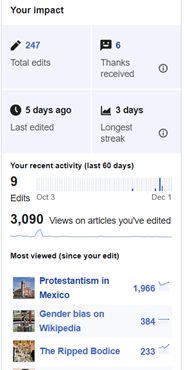
Watch this quick explainer to learn more: YouTube: The Newcomer Homepage
The Bottom Line
Wikipedia isn’t the endpoint of research: it’s a dynamic, collaborative bridge between public knowledge and academic work. By using it strategically, and contributing ethically, you can:
Quickly locate authoritative sources, curated by a global community
Understand how your research fits into public discourse
Gain Altmetric recognition if your work is cited
Directly contribute to open knowledge!
So next time you’re starting a new project, use the world’s top read online reference work, and consider giving back by adding well-sourced, balanced citations (including your own relevant work!) where they’re needed most. Your research (and the world’s readers) will thank you.
Join Silvia from the Wikimedia Foundation at Sage’s informative webinar coming up soon!
"Beyond Publication: How to Increase Citations and Academic Reach"
February 4th, 2026, 11am EST
Register here.