Teaching research methods in Politics & IR: Five key challenges for educators, and how to overcome them
Guest post by Anouk S. Rigterink and Mareike Schomerus
You are teaching a methods course in Politics and International Relations. Perhaps it is a course that has ‘research methods’ in the title. Perhaps the final assignment for your course is a research project. Perhaps you are convening a dissertation module. What challenges do you expect?
We might know some of these challenges, having taught research methods – many times, in fact, at the London School of Economics and Political Science, University of Chicago, University of Oxford and Durham University. For Anouk, this often involved teaching causal inference and statistics in departments where a good share of her colleagues conducted research nowhere near such approaches, and many students do not tend to think of themselves as statistics people. For Mareike, this often involved conveying to students how to research people’s experiences, how to interview and observe, and how to draw themes from text, in a department where research with statistics was the only type of research students had encountered. Challenges abound!
And yet, despite our very different approaches to research, we have collaborated for well over a decade, talking about research methods while sitting around a fire in South Sudan, watching goats and chickens roam and eating our rice and beans. At times, we idly speculated what it would look like if we were to take the teaching challenges we encountered and our experience of doing research to write a research methods textbook together.
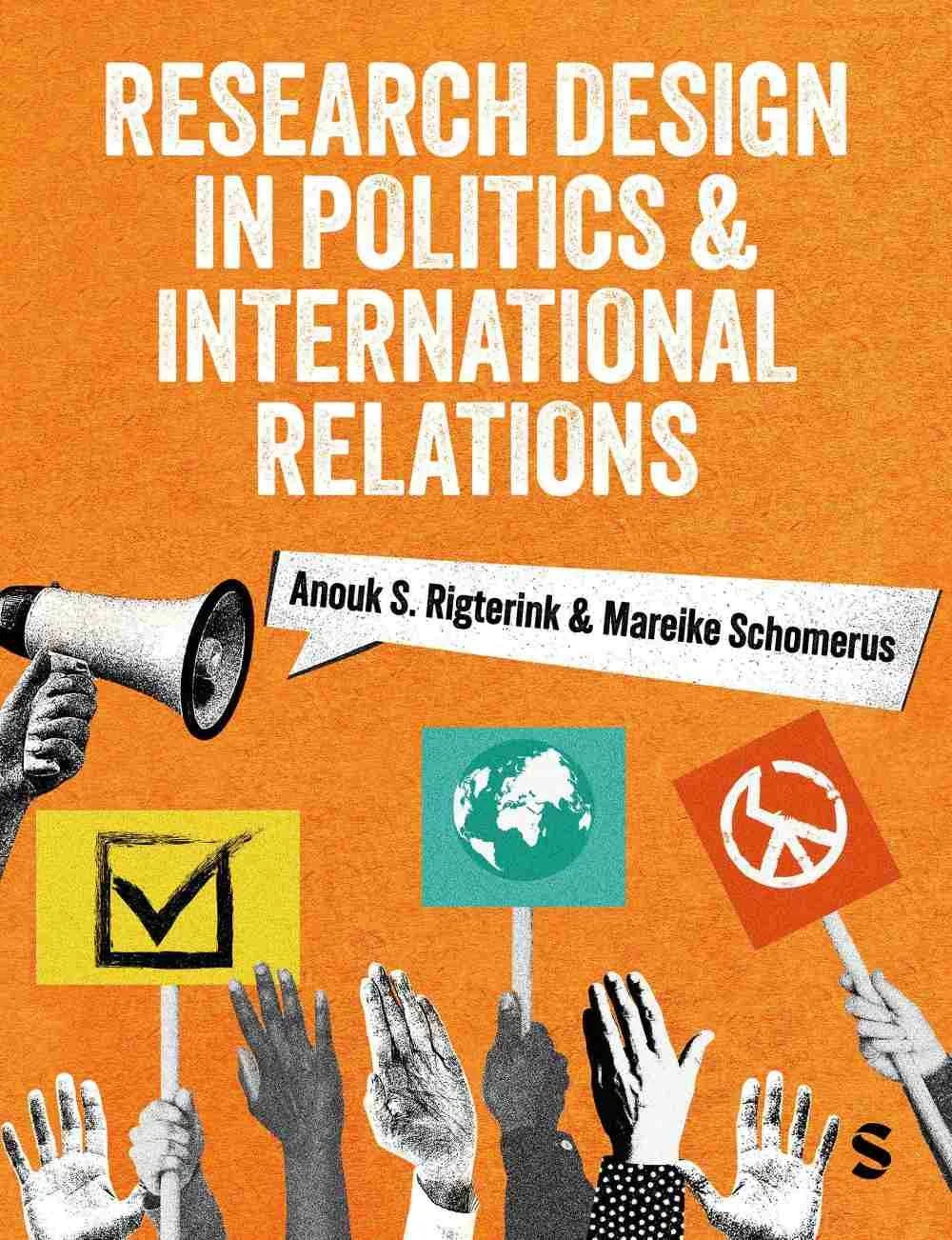
Fast-forward 15 or so years, and we have done it: Research Design in Politics and International Relations. What specific challenges inspired us to write this textbook? Here are five scenarios. They might be familiar to you, too.
1. Seminar challenge: “I just want to study [insert topic here]”
Students don’t typically come to Politics and International Relations for the methods. They are passionate about topics like climate change, equality or political polarisation. Methods can seem to them as something abstract, standing in the way of their interests—rather than something that allows them to pursue these.
How we dealt with this challenge
To show that methods are the pathway to interesting topics, we made a good portion of the textbook topic-led, covering the themes mentioned above as well as and war and violence, voting, identity, and social movements and protests. This shows students how they might ask different research questions about these topics and study them using different research designs (including experiments, process tracing, discourse analysis, or ethnography, among others). We don’t just show this in the abstract, but make it concrete by using recently published articles about each.
2. Grading an assignment challenge: tick-box theory/literature/methods section that does not connect to the rest of the assignment
It can be difficult for students to see how it all fits together: reading in the assessment instructions that they must engage with literature or theory and must describe their methods, does not always result in a coherent assessment. Maybe teaching is not entirely blameless, here: the most logical way to plan our lectures is also to disconnect the pieces of the research puzzle by discussing literature one week, theory the next. Bit by bit, but often unconnected.
How we dealt with this challenge
To bring it together, we are summarising the entire research process in a single chapter, a single figure even, to help students keep track of the bigger picture. We were not entirely sure about this: is there a better way to attract scathing critique than to claim to have summarised the research process not just for ourselves, but across the discipline of Politics and International Relations? However, we have presented this approach several times now. We think of it not just as a teaching tool, but also as a tool to facilitate giving better feedback on research outside of one’s methodological wheelhouse. It is also a tool to understand knowledge hierarchies. Being somewhat pleasantly surprised, we have received overwhelmingly positive reactions. Researchers and teachers from many methodological backgrounds recognise themselves in the research process as we present it.
3. In lecture challenge: “But [your colleague] said something different about what makes for good research!”
That we do not approach research in the exact same way as all of our colleagues is a good thing. Diversity is crucial in knowledge production. However, for students who hear from multiple sides about what good research is, this can be confusing.
How we dealt with this challenge
We present the research process as a series of interdependent choices. Some research questions go better with particular research designs. How we use theory affects how we select the cases we want to study. This affects how we sample, and what data we use. And all of this is shaped by our epistemology: the knowledge we think we can create through research. It is not the case that some choices are better than others, but they are choices that researchers must make, coherently. In that, students are no different from experienced researchers.
4. In office hours challenge: “Doing research is difficult, what am I doing wrong?”
Of course! Doing research is difficult, for us and students alike. But this is not always visible to students. Because when we write a book or article, it is not an account of all the stumbling blocks across our research journey, or our distractions and doubts when journeying. It is a polished account of what we ended up doing after overcoming them.
How we dealt with this challenge
We are so grateful to seven authors of articles that became examples of how to implement a research design. They offered an incredibly generous behind-the-scenes look, making visible how the research question we start out with is not always the one with which we end up; how not all data collection goes to plan; how hypotheses are unexpectedly not supported by evidence; how we grapple with knowledge hierarchies, and much more. They also shared practical tips on how they stay motivated, and how they dealt with inevitable difficulties, distractions, doubts and demotivation. Because we all have them—and it helps students a lot to know that!
5. That nagging voice in the back of students’ (and no-longer students’) heads challenge: “Can I really produce good research?”
Teaching research methods is about empowering students to become researchers, at least for the duration of their dissertation or research assignment. Many of us can relate to the occasional or not-so-occasional flash of imposter syndrome that comes with this: is what I’m doing actually good research?
How we dealt with this challenge
By offering a way through the research process, imagined as a set of choices, we show the diversity of coherent choices that are possible and give examples for these. By equipping students to make these choices, including by being honest about the challenges most researchers encounter, we hope to have helped you and other instructors to empower students to become confident and considered researchers.
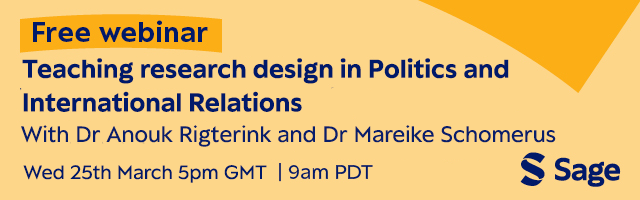
Free webinar: Teaching research design in Politics and International Relations: Wednesday, 25th March 5pm GMT / 9am PDT
Join Anouk S. Rigterink and Mareike Schomerus as they introduce ways in which teaching research methods can empower students to think like researchers, help overcome common student anxieties and reignite students’ curiosity for political questions. Register here
You can find out also more about their new key textbook Research Design in Politics and International Relations (2026) here.