
In Conversation with Peter J. Adams
Many researchers see theory and philosophy as abstract and intimidating. In this interview, Peter Adams explains why they are essential to strong research, how they shape better questions and methods, and why their importance is growing in the age of AI.
This post originally appeared on Sage blog Asia Pacific Insights here.
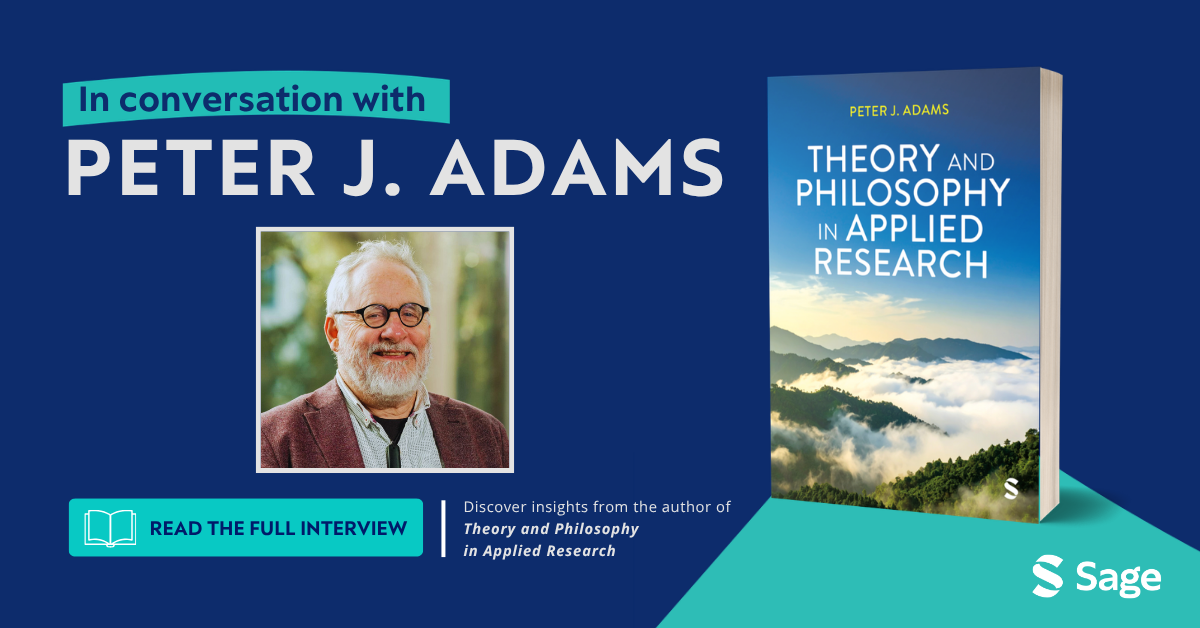
Many researchers see theory and philosophy as abstract concepts best left to academics. But what if they are actually the foundation of strong, original, and impactful research?
In this conversation, we speak with Peter J Adams about his latest book, Theory and Philosophy in Applied Research. Drawing on decades of experience as a researcher, educator, and clinical psychologist, Adams explains why theory matters, how it shapes better research, and why its role may become even more important in an age of AI.
This conversation offers practical insights for students, researchers, and educators looking to move beyond methods and discover the ideas that bring research to life.
Could you share a bit about your background and the journey that shaped your work today?
My initial postgraduate study was in philosophy, focusing particularly on continental European and Neo-Confucian philosophies. This introduced me to the excitement of exploring ideas. I then shifted focus and qualified as a clinical psychologist and practised in a range of settings, specialising in addictions and violence. This reinforced for me how important ideas are for working with people. I encountered firsthand the multiple layers and complexities of the challenges people face in difficult circumstances. After completing a PhD in psychology, I took up teaching and research roles in a health faculty, where I developed courses and programmes in addictions, theory, community development, and mental health. This highlighted for me the critical role that learning about theory plays in advancing approaches to wellbeing. At the same time, I pursued applied research projects in a diverse range of areas, including approaches to violence against women, family impacts of addictions, applied rhetoric, the existential aspects of life transitions, and the political influence of unhealthy commodity industries (e.g., alcohol and gambling). It was during this time that I deepened my appreciation of what critical and discursive social theory had to offer in tackling major societal challenges. This led me to write a series of sole-authored books in which I explore applications of theory and philosophy to practical issues. This book evolved as a natural extension of this series.
Many students and early-career researchers see theory and philosophy as abstract or even intimidating. What inspired you to write this book, and how did you approach making these concepts more accessible and relevant to applied research?
Over the years, I have supervised many master's and doctoral students, mostly on applied research projects, and what has repeatedly worried me is their reluctance to engage with theory and their avoidance of relevant traditions of thinking. This reluctance seriously reduces the quality of their final work. For example, in a PhD project on resilience to incidents of abuse, a theory-reluctant student missed out on relevant contributions from systems and social theories, as well as on concepts such as social cohesion and recovery capital. In the early 2010s, I sought to address this reluctance by designing and teaching a postgraduate course on research theory and philosophy. Over the next 12 years, I experimented with various ways to present content and sought student feedback. For example, I learnt that the most effective way to introduce critiques of empiricism was not to do so gradually but to go straight in; it was a pain threshold that needed to be addressed before moving on to other areas. The problem is that many disciplines, such as applied psychology and health sciences, have not adequately introduced students to underlying theories and philosophy. This is not the student’s fault; rather, it's the fault of curricula that have neglected to prepare them for this space. Another adjustment that students helped me with concerned the diversity of theorists. Most students in the course were neither European nor male, so they often questioned and sometimes challenged me on why most theorists I talked about were dead European men. They helped me in gradually diversifying the offering by including more women and theorists from other cultures. The course slowly evolved into the cascading structure presented in the book, with four big domains consisting of multiple theory movements, then broken down into threads of interlinked theorists connecting on particular key ideas.
Your book brings together theory, philosophy, and real-world research practice. Why is it important for applied researchers to engage with philosophical thinking rather than focusing purely on methods and outcomes?
As argued in the first chapter, theory and philosophy are essential to many of the key ingredients in assembling a strong academic work. First, theory plays a critical role in shaping the ideas and concepts that underpin a work's main argument. The quality of this argument is central to what a work seeks to communicate. Second, theory plays a key role in the creative aspects of research and in what enables a work to make an original contribution. Originality emerges from the novel combination of ideas and concepts. This is important, particularly for PhD projects. Third, theory is vital to the quality of criticism and critical thinking incorporated into a work. Theories typically have a lineage in the history of ideas in which scholarship on the strengths and weaknesses of most types of theory is already available. An understanding of these can help in critiquing both one’s own ideas and those of others. Finally, the strands of theory running through a work, as well as those underpinning the methods, are crucial to what holds an academic work together; to what gives it coherence. A limited set of well-articulated key concepts will provide a means to connect the various parts of a work. Theory can be likened to the action of yeast in baking a cake; if the various ingredients in a work are assembled correctly—including theory—then the yeast will become active, permeating through the whole work and helping to generate a successful product. Taken together, these capacities—conceptualisation, creativity, criticism and coherence—are all derived from applications of theory, and as they permeate a work, they play a key role in determining its overall merit. This, I would argue, applies equally to applied research, as it does to pure, practical and transformational research.
A common challenge for students is connecting their research questions to the right theoretical or philosophical framework. Based on your experience, where do most researchers struggle, and how can they navigate this more confidently?
Research students often struggle to understand the theoretical basis (or ‘methodology’) underpinning their choice of research methods. It is difficult for them to figure out the fundamentals of a methodology—its ontology and epistemology—when they lack familiarity with relevant theory and philosophy. Instead, they gravitate towards methodologies commonly used by those around them or towards the methodological preferences of senior staff and supervisors. This can lead to adopting unsuitable methods for what they really want to find out. For example, they might adopt methodologies suited to studies of lived experience (e.g., hermeneutics), when what they are really interested in is normative beliefs; a focus more suited to discursive approaches (e.g., critical discourse analysis). What would help them here is developing their own capacity to understand and critique methodological assumptions. Likewise, beyond methodology, readers can also benefit from developing an appreciation for the other roles that theory plays in an academic work. The approach I take avoids looking at theory in any one place and, instead, sees it as operating simultaneously at different levels throughout a work. I address these issues directly in the final three chapters of the book. In Chapter 13, readers are presented with a range of alternative methodologies and then invited to take their research question through a series of exercises which contrast what two or more of these methodologies deliver, and then to interrogate which one best suits their needs. In Chapter 14, the action of theory throughout a work is explored across six ‘layers’ of theory, each layer playing a different role in assembling the work’s central argument. The final chapter guides the reader through a series of exercises to identify their main interests in theory and how they plan to explore them in the future.
Since the publication of this edition, how have you seen the role of theory and philosophy evolve in applied research, particularly in areas influenced by digitalisation or AI?
We currently have access to a considerable number of books and articles providing guidance on research methods, but little is available for guidance on its companion area, research theory and philosophy. Perhaps the topic has, in the past, been viewed as too big and too diffuse. But as approaches to researching people become more complex and diverse, the ability to engage with theory is increasingly important. For example, more researchers are engaging in collaborative methodologies such as participatory action research, co-design, and transdisciplinary approaches. Generative AI is certainly impacting how we conduct and communicate research, but I would argue that this will give theory an even stronger role in the future. AI applications help enormously in pulling together available sources, but are not so good at unpacking underlying thinking. Indeed, this capacity may take a more prominent seat as we shift away from assembling content and toward the merits of underlying concepts and ideas.
For educators teaching research methods, how can your book support more meaningful classroom discussions and help students move beyond a purely technical understanding of research?
The book introduces and guides readers through the main domains of theory, carefully presenting key concepts and equipping them with the vocabulary to navigate the content. It does so in a friendly and reassuring way, with repeated encouragement to explore ideas further. The book incorporates several features to enhance reader interest and engagement. Each chapter begins with an explanatory dialogue to orient the reader to the central themes, followed by an introductory overview of key concepts. In each section of a chapter, the discussion is framed around arrays (or ‘threads’) of interconnected theorists whose ideas collectively capture the central preoccupations of this area of thinking. Throughout every chapter, readers are invited to participate in thought exercises that highlight key aspects of coverage. These exercises are designed for both class activities and individual study. Tables and diagrams are frequently used to summarise and clarify key ideas, and each chapter finishes with a list of recommended readings. Accordingly, the book provides those teaching research methods with multiple opportunities to incorporate its material into classes and to supplement teaching with self-directed learning.
If there is one mindset shift you hope readers take away after engaging with this book, what would it be, and how might it change the way they approach their own research?
My main hope for readers is that the book demystifies the world of theory, provides them with a road map for navigating its twists and turns, and increases their willingness to explore what theory has to offer. While a book like this cannot hope to cover the many thousands of thinkers who have published on theory, it still introduces readers to over two hundred theorists and gives them a taste of some of their ideas. Accordingly, the book can be likened to a very large box of chocolates from which readers might sample some ideas, gain a sense of what interests or excites them, and this, as I say at the end of the book, “not only opens a window on the wonderful world of theory but it also prompts your interest in discovering new people and new spaces and whets your appetite for more adventures.” And, furthermore, that once readers “gain a sense, or a whiff, of what the ideas might reveal, then you would continue further under your own steam.” This is what the book intends; it invites readers to reevaluate their relationship to theory and philosophy, and to feel adequately inspired and equipped to embark on their own journeys of enquiry.