
What causes what? Using causal mapping to analyse qualitative data at scale
Guest post by Gabriele Caldas Cabral, Steve Powell and Alastair Spray
A persistent challenge in qualitative research is synthesis. When you are working with large volumes of text (interviews, field reports, narrative accounts) across multiple countries and time periods, how do you move systematically from individual accounts to broader patterns? And how do you do so without flattening the complexity that makes qualitative data valuable in the first place?
This piece describes how causal mapping, combined with an AI-assisted coding workflow, helped address that challenge in a large, multi-country research and evaluation project and what researchers working with similarly complex qualitative datasets might take from the experience.
What is causal mapping?
Causal mapping is a structured method for representing causal claims drawn from qualitative texts, first used by Axelrod (1976). When people explain what happened and why ( in interviews, reports, or written accounts), they make causal arguments: this led to that, because of X, X influenced Y…. Causal mapping captures these claims systematically, representing them as directional links between factors, which can then be visualised as a network and interrogated analytically – see Powell et al (2024).
Researchers familiar with tools like NVivo or MAXQDA will recognise the basic impulse: to work systematically with qualitative text. The difference is that causal mapping is specifically focused on causal claims rather than themes or categories. Where thematic coding asks what is this about, causal mapping asks what does this person say caused what. It preserves the connected, narrative logic of people's causal arguments rather than reducing them to counts or labels. The resulting maps can be filtered by theme, source, sentiment, or time period, allowing researchers to compare perspectives and identify where narratives converge or diverge.
The approach has roots in cognitive mapping and systems thinking, and has been in use across the social sciences for nearly five decades, from political science and organisational research in the 1970s and 80s through to more recent applications in policy analysis and international development (Powell et al., 2023). It tends to be most useful when the research question is itself causal, not just what do people think but what do they believe drives change, and how.
The challenge: too much text, too much complexity
Alastair Spray, Senior Consultant at INTRAC (a UK-based non-profit that supports civil society organisations worldwide), faced exactly this kind of synthesis problem. He was part of a team leading the qualitative analysis component of an end-term evaluation of a large civil society programme spanning 13 countries and four years.
The primary data collection method was Outcome Harvesting - an evaluation methodology in which stakeholders document notable changes they have witnessed and explain what contributed to them (Wilson-Grau, 2018; Wilson-Grau & Britt, 2013, Britt et al, 2025). This generated a large body of rich, narrative data. The challenge was not the quality of the data; it was the sheer volume and complexity of it. As Alastair put it: "They felt that they couldn't understand the big picture, for the whole programme, but also for specific countries too."
The research questions were also layered: How did different types of intervention compare across national and local levels? Were there shifts in the causal logic of the programme between its earlier and later years? How did patterns vary by country and region?
Applying AI-assisted causal mapping with INTRAC
Working with Causal Map Ltd, the INTRAC team used an AI-assisted workflow to process a large and varied dataset: Outcome Harvesting data from all 13 countries across four programme years, and narrative documents from partner organisations. Causal mapping has a long tradition of manual coding but for this volume of data Alastair decided to use AI support.
Causal mapping has a long tradition of manual coding, but for this volume of data, and given the budget limitations that would have made a fully manual approach impractical, the INTRAC team, led by Alastair, decided to use AI support. The coding used a zero-codebook approach (Powell & Caldas Cabral, 2025): rather than applying a pre-defined codebook, the AI model (Gemini 2.5 Pro) was instructed to identify and label causal claims directly from the text, without prior categories. From this process, 5,430 individual causal claims were extracted and automatically coded for sentiment (whether the link represented a positive or negative relationship). This is particularly useful when researchers want to stay close to the data and avoid imposing an analytical frame before the patterns have emerged.
Given the sensitive nature of some of the programme data (which involved civil society actors working in challenging political contexts), the team worked to ensure all data was fully anonymised before any mapping or analysis began. AI-assisted causal mapping can be an appropriate methodology even with sensitive data, provided these steps are built into the workflow from the outset.
The outputs were then reviewed and refined collaboratively. Alastair learned to use the Causal Map platform directly, allowing him to interrogate the maps, apply filters, and generate written analytical summaries ("vignettes") using the platform's built-in AI function.
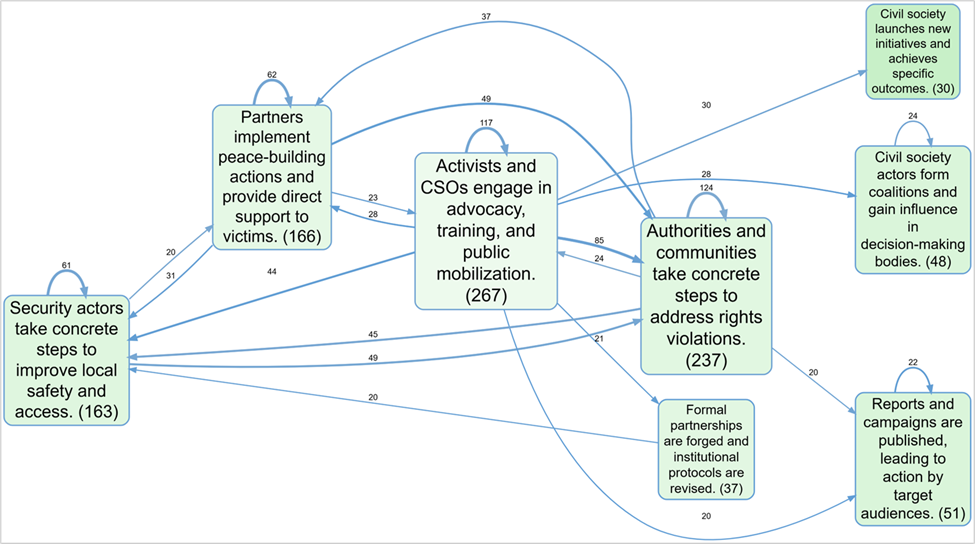
Figure 1: Overall programme causal map
What the analysis produced
The result of all this is a very large interconnected causal map, which we can query and filter to answer specific questions. At the highest level, a programme-wide map revealed the dominant pathways as perceived by stakeholders across all 13 countries. Below this, individual country maps allowed for direct comparison across different contexts. Filtering the data by time period made it possible to examine how causal patterns had shifted over the course of the programme.
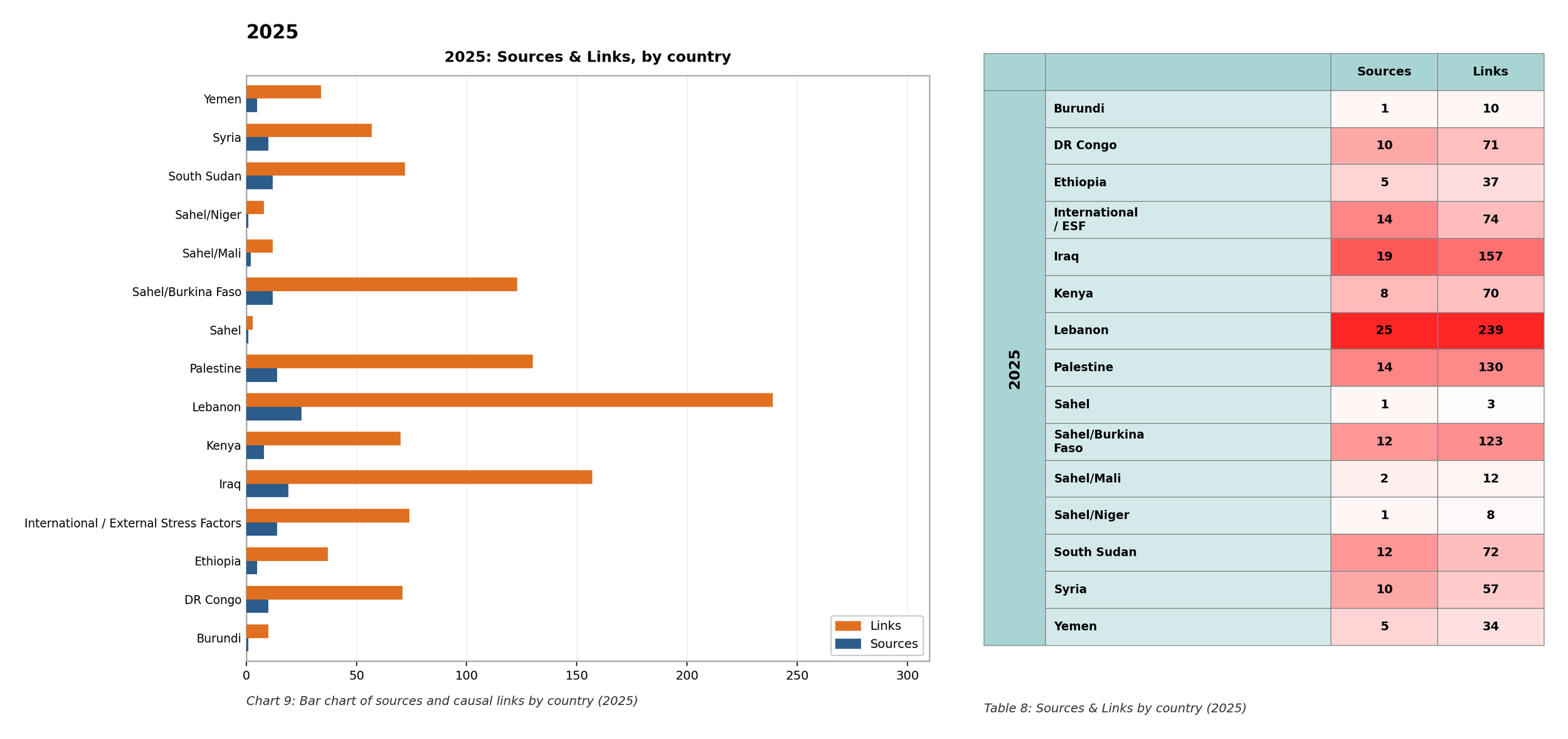
Figure 2: Bar chart and table showing the number of sources and links per country in 2025
As Alastair noted: "Causal Map really allowed us to get that higher level of understanding, in both a clear visual but also high quality written analysis."
Methodological reflections
A few things are worth noting for researchers considering this approach. Zero-codebook approach produces exploratory results that require careful review. It works best as a starting point for analysis rather than a finished product. Researchers should expect to spend time interrogating and refining the outputs rather than treating them as complete.
The transparency of causal mapping is also worth emphasising. Because the causal claims are made explicit and visible, the assumptions embedded in the data become discussable, both within a research team and with participants or stakeholders. This is analytically useful and can also support more reflexive practice.
Finally, confidence with the approach comes through use. Alastair's advice to other researchers was straightforward: start, and ask for help as you go.
The full case study, along with further methodological documentation, is available here.
A bibliography of causal mapping literature can be found here.
References
Axelrod, R. (1976). The Analysis of Cognitive Maps. In Structure of Decision: The Cognitive Maps of Political Elites.
Britt, H., Powell, S., & Cabral, G. C. (2025). Strengthening Outcome Harvesting with AI-assisted causal mapping (Causal Pathways Initiative: Case Studies). Causal Pathways Initiative. https://5a867cea-2d96-4383-acf1-7bc3d406cdeb.usrfiles.com/ugd/5a867c_ad000813c80747baa85c7bd5ffaf0442.pdf
Powell, S., Copestake, J., & Remnant, F. (2024). Causal mapping for evaluators. Evaluation, 30(1), 100–119. https://doi.org/10.1177/13563890231196601
Powell, S., & Caldas Cabral, G. (2025). AI-assisted causal mapping: a validation study. International Journal of Social Research Methodology, 1–20. https://doi.org/10.1080/13645579.2025.2591157
Powell S, Larquemin A, Copestake J, et al. (2023) Does our theory match your theory? Theories of change and causal maps in Ghana. In: Simeone L, Drabble D, Morelli N, et al. (eds) Strategic Thinking, Design and the Theory of Change: A Framework for Designing Impactful and Transformational Social Interventions. Cheltenham: Edward Elgar, 232–50.
Wilson-Grau, Ricardo (2018): Outcome Harvesting: Principles, Steps, and Evaluation Applications. Charlotte, NC: Information Age Publishing.
Wilson-Grau, Ricardo / Britt, Heather (2013): Outcome Harvesting. Cairo: Ford Foundation, Middle East and North Africa Office (Revised November 2013).