
Visual Data Collection meets Data Visualization
Researchers can start visualizing data from the beginning of the study by using visual methods to collect visual data. Technology tools help us capture and analyze visual exchanges with participants.

Researchers are awarded grants to study Facebook data and its influence on elections
Last year saw the launch of Social Science One—a model devised to allow academic researchers access to the huge amounts of data generated by private industry, including Facebook data which will constitute the inaugural project. This week the first grants have been announced in partnership with the Social Science Research Council. Twelve projects have been awarded grants, as over 60 researchers come together from 11 countries and 30 academic institutions to study social media’s impact upon our society and democratic systems.

Three exciting possibilities for combining data science and social science
As the leader of a data science team at the Urban Institute, I get to work on interesting issues that intersect data science and social science every day. By data science, I mean technical tools, architectures, and processes that are borrowed from computer science and are atypical in the social sciences. This is a slightly more limited definition than most would have for the term data science, but because so much of what defines a data scientist at Urban also defines a researcher — cleaning data, analyzing it, visualizing results, etc. — my definition draws a finer line.
Qualitative Data Analysis with ATLAS.ti: Author Interview
Susanne Friese discusses the new edition of Qualitative Data Analysis with ATLAS.ti.
Qualitative Data Analysis with NVivo: Author Interview
NVivo and Atlas ti are popular data analysis software options for qualitative research. Two important books that guide researchers who want to use these CAQDAS are newly updated. In this post we hear from Kristi Jackson, co-author with Pat Bazeley of Qualitative Data Analysis with NVivo. In the next post we will hear from Susanne Friese, author of Qualitative Data Analysis with ATLAS.ti.

Collecting social media data for research
Human social behavior has rapidly shifted to digital media services, whether Gmail for email, Skype for phone calls, Twitter and Facebook for micro-blogging, or WhatsApp and SMS for private messaging. This digitalization of social life offers researchers an unprecedented world of data with which to study human life and social systems. However, accessing this data has become increasingly difficult.

An interview with the Allen Institute for Artificial Intelligence, winners of the NYU Coleridge Initiative's Rich Context Competition
Earlier this year Allen AI were announced as the winners of the NYU Coleridge Initiative’s Rich Context Competition. The goal of the competition was to automate the discovery of research datasets and the associated research methods and fields of social science research publications. You can find out about all the finalists and their work here.
We caught up with Allen AI to talk about the work and their involvement in this year’s competition.

Computational social science: A new way of working and a new way of thinking
I would argue that computational social science necessitates collaboration, and indeed is tamed by it. A collaborative approach provides the necessary structure, goals, and a critical approach to research methods. In response to the question of what computational social science has helped me achieve, it may seem obvious to mention the concrete projects, the outputs, the measurable outcomes. However, for me computational social science has achieved something more substantial and enduring—a new way of working, a new way of thinking, and a new kind of enthusiasm for research.
Becoming a Citizen Scientist-3
Thinking about citizen science and your career? Read perspectives of citizen scientists Jim Salmons and Timlynn Babitsky in this 3-part interview.
Citizen Scientists at Work-2
Citizen Science offers new opportunities to engage in research activities. Learn about #CitizenHistory and #CitizenScience in this interview.
What does it mean to be a citizen scientist? - 1
April 13 is Citizen Science Day. MethodSpace explores citizen science from the perspectives of citizen scientists.

Matchmaking tools: Augmenting the relationship between research and industry
On a Friday evening in 1922, you could turn on the radio in Schenectady NY and hear Hermann Briggs talking about the latest research and discoveries around common disease and illnesses. Radio, and later TV, were the most exciting and widest reaching media platforms where research knowledge could be shared with the public.
Today, researchers have access to a whole host of media (podcasts, YouTube channels, Ted Talks, etc.) to talk about their research and how it can be fun or useful for the public.

Artificial intelligence for entity resolution with Jeff Jonas
Jeff Jonas, the world’s foremost expert on entity resolution and the inventor of the original NORA (Non-Obvious Relationship Awareness) technology developed for Las Vegas casinos, brings entity resolution to life. This unique technology (an IBM spin-out) is a purpose built real-time AI for delivering human quality entity resolution – determining “who is who” and “who is related to who” – without training, tuning or experts.

Book review: Artificial unintelligence: How computers misunderstand the world by Meredith Broussard
This book will be of particular value to social scientists interested in the political, economic and social dynamics of AI and data-driven technology. It will also be of interest to investigative and data journalists seeking to leverage computational tools.
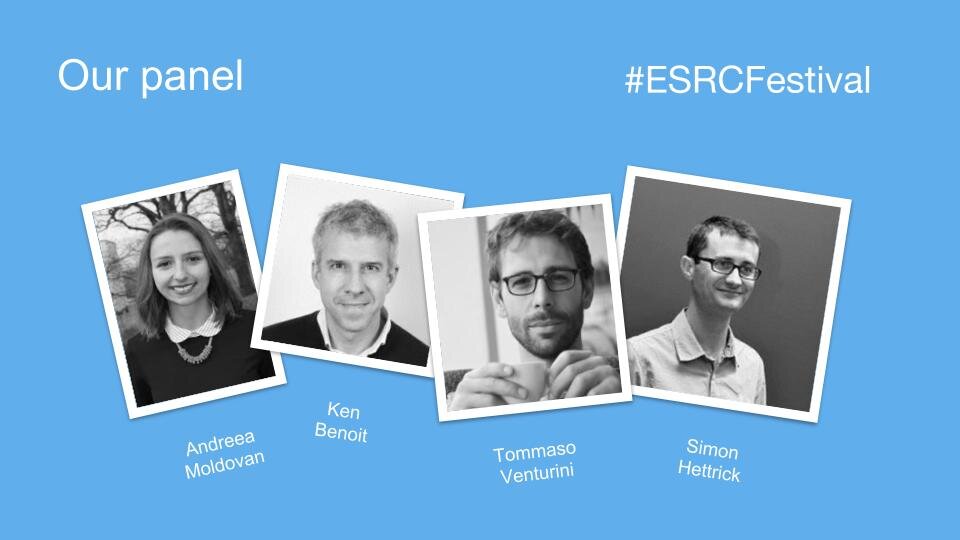
What skills will the future social scientist need?
Watch our panel event from the ESRC Festival of Social Science on what skills social scientists will need to be able to do the social research of the future.

Data Summit at #DataFest19: Conference roundup
As part of Scotland’s annual DataFest, the 2019 Data Summit conference took place in Edinburgh on 21-22nd March and was packed full of eye-opening sessions from speakers at the cutting edge of data driven innovation.


Learn data science with new video collection
SAGE Research Methods has launched a new Data Science video collection, with hours of educational material for researchers of all levels and backgrounds.
