

Ethical Research with Children
What are some ethical issues to consider when seeking consent and planning research with children? Find recommendations and resources in this post.

Two Researchers on Ethics: Video & Podcast
Listen to Drs. Helen Kara and Suzanne Albary share their thinking and questions about research ethics in a video and a podcast.

Ethics & Ethnography
Dr. Liz Przybylski introduces an open-access chapter about ethical consideration for online or on-ground ethnography.

Emotion and reason in political language
In the day-to-day of political communication, politicians constantly decide how to amplify or constrain emotional expression, in service of signalling policy priorities or persuading colleagues and voters. We propose a new method for quantifying emotionality in politics using the transcribed text of politicians’ speeches. This new approach, described in more detail below, uses computational linguistics tools and can be validated against human judgments of emotionality.

Who is responsible for the conduct of ethical research?
Dr. Cheryl Poth discusses basic principles and key ethical issues for researchers.

Sociocultural Frameworks as a Humanizing Research Tool (Part 2)
Read part 2 of the series about humanizing methodologies by William Thomas.

One Year Anniversary of Teaching Methods Online
A year from the beginning of the pandemic, Dr. Ravitch offers "Methods Pedagogy for Practitioners: Supporting Students’ Wisdoms of Practice"

Sociocultural Frameworks as a Humanizing Research Tool in contextualizing Black Male Teacher Retention
This series of MethodSpace posts by William Thomas will introduce a blueprint to developing a humanizing research methodology.
Let's take a big-picture look at "research ethics"
From the premises and assumptions that precede the definition of the research problem, to the shape and form of publications, to the protection of participants seen or unseen, researchers face decisions that compel them to consider their own moral compasses.

Gender and Research: Resources for International Women's Day
It is International Women's Day! Find research resources in this SRM Reading List.

From Princeton to London via Chicago: My Summer Institute in Computational Social Science journey
Continuing our series on the Summer Insitute in Computational Social Science, Joshua Becker traces his SICSS journey.
Before I get into this, you should know I’m a network researcher. So even though this is ostensibly about a summer program, it’s also about networking. I almost didn’t participate in the Summer Institute in Computational Social Science, or SICSS as I now know it fondly. At the time, I thought it was just about learning the skills — and I felt I had a solid methods foundation — and mainly just applied because it seemed like the kind of thing I was supposed to do as a grad student. Having never previously seen the gorgeous Princeton campus, I imagined the trip itself as little more than spending two weeks in suburban New Jersey rather than at home with my wife. Luckily, I applied. And luckily, I was accepted. Mileage may vary, but I made out well on the deal.
March Focus: Designing an Ethical Study.
It is a new month, so we have a new focus: ethics.

Choosing Creative Methods: Conversation with Nicole Brown
Nicole Brown explains the way she uses creative methods, and why she designs studies with this approach.


Figuring Out What to Do: Making Methodological Decisions Across our Practices
Thinking about research in practice.

Action Research: A Collection of Posts
Find the entire collection of posts from the October 2020 series on action research!

Understanding institutions in text
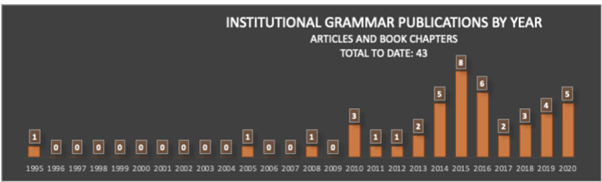
Institutions — rules that govern behavior — are among the most important social artifacts of society. So it should come as a great shock that we still understand them so poorly. How are institutions designed? What makes institutions work? Is there a way to systematically compare the language of different institutions? One recent advance is bringing us closer to making these questions quantitatively approachable. The Institutional Grammar (IG) 2.0 is an analytical approach, drawn directly from classic work by Nobel Laureate Elinor Ostrom, that is providing the foundation for computational representations of institutions. IG 2.0 is a formalism for translating between human-language outputs — policies, rules, laws, decisions, and the like. It defines abstract structures precisely enough to be manipulable by computer. Recent work, supported by the National Science Foundation (RCN: Coordinating and Advancing Analytical Approaches for Policy Design & GCR: Collaborative Research: Jumpstarting Successful Open-Source Software Projects With Evidence-Based Rules and Structures ), leveraging recent advances in natural language processing highlighted on this blog, is vastly accelerating the rate and quality of computational translations of written rules.

Collaborative Thinking & Writing about Methodology
The authors of "Making Sense of Social Research Methodology: A Student and Practitioner Centered Approach" discuss their new text.

Choosing a Methodology
How do you choose a methodology for a qualitative study? See this collection of articles.